blog
Do product reviews affect AI recommendations?
Product reviews have steered online buying for years. A product with hundreds of positive reviews feels like a safer bet than one with none, which is why stores put so much effort into collecting ratings, showing testimonials, and nudging customers to share their experience.
A newer question is worth asking: do reviews also influence what ChatGPT, Gemini, Claude, Perplexity, and Grok recommend? They can, though not in the way most merchants expect. An assistant doesn't just read star ratings and name the highest scorer. Depending on the system and the question, it may draw on review summaries, editorial comparisons, customer experiences, shopping data, and other sources to decide which products are relevant.
There's a second problem hiding underneath. Many stores show their reviews through JavaScript widgets. The reviews look normal to a shopper, but the underlying content can be hard for some crawlers and AI retrieval systems to reach. So a merchant can be collecting valuable feedback while keeping part of it away from the systems now involved in product discovery.
How AI assistants use product reviews
Picture someone asking an assistant, "What's the best lightweight travel stroller for a three-year-old?" A traditional search engine returns product pages, buying guides, comparison articles, and shopping results, and the shopper does the reading. An assistant compresses most of that into one answer: it might name three strollers, explain the differences, and say which suits air travel, uneven terrain, or compact storage.
To write that answer it needs information about the products. Specifications help, but they don't tell the whole story. A stroller can weigh six kilograms and still be awkward to fold; headphones can advertise strong noise cancellation and still hurt after two hours. Those are the details customers put in reviews, and when an assistant can read them, that feedback helps it understand how a product behaves in the real world.
The distinction that matters: reviews are potential evidence for a recommendation, not a guaranteed ranking signal. Different assistants use different retrieval methods and sources, and none of them publishes a complete account of how it weighs customer reviews against everything else.
A five-star rating isn't always enough
Take two products. Product A has 4.9 stars from 35 customers. Product B has 4.6 stars from 2,400. Which should an assistant recommend? There's no obvious answer: A has the higher average, B has far more feedback, and the written reviews might reveal real differences in durability, support, or fit.
Now the question narrows to "which running shoes are most comfortable for wide feet?" The average rating barely helps. What matters is whether reviewers actually discuss fit, toe-box width, and cushioning over distance. A product with a slightly lower overall score can be the better match.
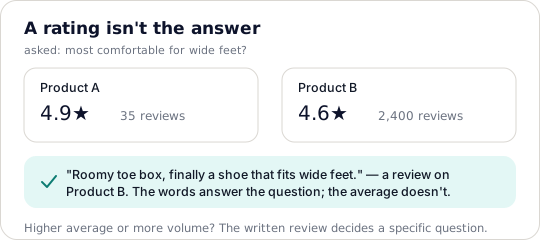
The star average doesn't answer a specific question. The sentences inside the reviews do.
This is where the written content earns its place. A review that explains why a product works for a particular use is more informative than a five-star rating with no context. That isn't proof that AI systems systematically favour detailed reviews; it's just that detailed reviews hold information that supports more specific recommendations. For merchants, it points at collecting meaningful feedback rather than chasing the average star score alone.
Where do assistants get their review information?
Not every assistant opens your product page and reads your review section before it answers. Some use search engines or other retrieval services. Others pull product information through shopping integrations, indexed pages, comparison articles, or specialist review platforms, and their answers can also reflect what the model learned in training.
So customer feedback can reach an answer by several routes. A product might be discussed in an independent review article, carry thousands of ratings on a shopping platform, or come up in Reddit threads and retailer listings. Google's Product Ratings program, for instance, aggregates reviews from merchants, aggregators, review sites, and Google users, and those can appear in eligible shopping listings. That doesn't prove Gemini reuses the same ratings in every answer, but it shows review data lives well beyond your own site. The practical consequence: AI visibility isn't decided only by the content on your product pages. Your reputation across external platforms becomes part of the information an assistant can draw on.
The hidden problem with JavaScript review widgets
This is one of the more overlooked technical issues in e-commerce. Plenty of Shopify, WooCommerce, and other stores show customer feedback through a third-party review app, usually a JavaScript widget. When a shopper opens the page, the browser runs the script, fetches the review data, and draws the stars, cards, photos, and pagination. To the shopper it all looks fine.
A crawler can see something very different. The initial HTML might hold little more than a placeholder:
<div id="customer-reviews"></div>
The reviews arrive later, once JavaScript runs. A browser handles that, and some search crawlers do too. Others don't execute JavaScript, don't wait long enough for the reviews to load, or don't interact with the widget the way a person would.
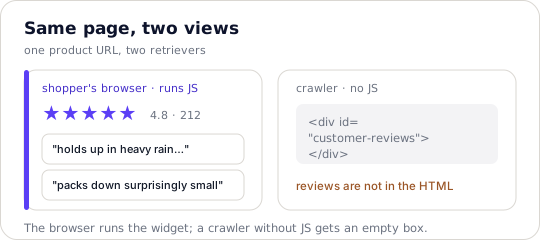
Same product page. The shopper's browser runs the widget and sees the reviews; a crawler that doesn't execute the script sees an empty box.
Google is explicit that its search crawler renders JavaScript, and equally explicit that not every bot does, which is why server-side rendering and pre-rendering still matter. A review section can be visible to shoppers and absent from the HTML some automated systems retrieve. If the reviews aren't available to a retrieval system, it can't use their contents from that page. To be precise: JavaScript reviews aren't automatically invisible to AI assistants, they're just more dependent on how the content loads and how each crawler works.
Why this matters for AI product discovery
Say a merchant sells a waterproof hiking jacket. The page lists the usual specs: waterproof rating, fabric, sizes, weight. Below that, a few hundred customers mention it holds up in heavy rain, fits over layers, and packs down small.
Someone asks, "What's a good lightweight waterproof jacket for hiking in Scotland?" The specs establish that the jacket meets the basic requirement. The reviews add evidence about how it performs in the conditions the buyer actually cares about. If those reviews are reachable, a retrieval system may use them. If they sit behind a widget it can't process, that evidence is missing. The jacket won't necessarily vanish from AI recommendations, since the assistant might find the same points elsewhere, but the merchant has made one of its own sources harder to reach. That's avoidable.
There's an accessibility issue here too
The same widget problem can affect people using assistive technology, though the technical reasons differ. Screen readers like NVDA, JAWS, and VoiceOver work from the browser's accessibility tree, built from the DOM and its semantics, so content added by JavaScript can be perfectly accessible. It doesn't have to be in the original HTML.
The trouble starts with poor implementations. A "load more reviews" button that doesn't announce the new content, a rating shown as five star icons with no text equivalent, filters that can't be driven by keyboard, an expanded panel that doesn't manage focus. A sighted mouse user never notices. Someone on a screen reader or keyboard can find the whole section unusable. Accessible review widgets need more than visible text: semantic HTML, real labels, keyboard support, sensible focus, and announcements when content changes.
There's an overlap with AI accessibility, but they aren't the same requirement. A widget can be accessible to screen readers and still hard for a non-JavaScript crawler to retrieve, and the reverse happens too. A good implementation handles both.
Should reviews live in the HTML?
For the review content that matters, yes, put it in the initial HTML. That doesn't mean rendering thousands of reviews on every page, which brings its own problems with page weight and performance. The practical version is to render the essentials directly: the average rating, the review count, and a handful of representative reviews, with the rest behind pagination or progressive loading. The point is that important information shouldn't live only inside a client-side widget some systems can't process.
Server-side rendering or static pre-rendering helps here. The server delivers meaningful HTML with the review information, and JavaScript enhances it with filtering, sorting, and loading more. It's a sturdier foundation for both people and crawlers. It's also worth making sure review content is tied to the right product and that any separate review pages use sensible, crawlable URLs.
What about Product and Review structured data?
Structured data is the other half of the conversation. With Schema.org vocabulary you can describe products, ratings, reviews, prices, and availability in a standard format: Product data can carry an aggregateRating, and individual reviews can use the Review type. Google supports these for eligible product results, including review snippets.
Structured data is not a shortcut to better AI recommendations, though. There's no reliable evidence that adding AggregateRating markup makes ChatGPT, Claude, or Gemini recommend a product more often. Markup helps systems interpret information; whether a given assistant uses it depends on its own retrieval and processing. It also has to follow the rules: review and rating markup must match what users can actually see on the page. Don't invent ratings, merge unrelated reviews, or mark up content customers can't reach. Structured data should describe genuine review content, not stand in for it. The strong version pairs accessible, customer-facing reviews with accurate markup.
Don't confuse Google's reviews system with customer ratings
One more distinction. Google runs a reviews system that recognises high-quality standalone review content, the detailed evaluations and comparison articles. That's different from the customer reviews in a store's review section. Google says plainly that its reviews system doesn't judge third-party customer reviews on product pages the way it judges standalone editorial reviews. So when someone says "Google rewards reviews," it's worth asking which reviews. Independent testing, customer ratings, merchant reputation, and structured review data are related but not interchangeable, and the same caution applies to AI recommendations: a detailed independent comparison contributes different information from an aggregate rating on a retailer's page. Both are useful, for different jobs.
Do negative reviews hurt AI recommendations?
They might, depending on what they say and whether the assistant uses them. Suppose a product is well liked but draws a recurring complaint about battery life. Ask for the best device for long trips without charging and that complaint is suddenly relevant, so an assistant leaning on those reviews might steer elsewhere or name the limitation. Ask for a device used mostly at home and battery life barely matters.
That's why sentiment shouldn't collapse to a single positive-or-negative score. A negative review can carry useful information about when a product isn't the right fit, and a glowing one might describe a benefit that only matters to a few buyers. The goal isn't to scrub every critical comment. Honest reviews, including the critical ones, help customers understand what they're buying, and trying to manipulate reviews damages trust well beyond AI search.
What Shopify and WooCommerce merchants should check
Before reaching for complicated AI optimisation, look at how your existing reviews are delivered. Open a product page, view the original HTML source, and search for a distinctive line from a visible review. If it isn't there, it's probably loaded dynamically. That alone doesn't prove the reviews are invisible to Google or assistants; the next step is to inspect the rendered HTML and test whether search engines can actually retrieve it. Google's URL Inspection tool and Rich Results Test both help. It's also worth checking your review app's settings, since some offer SEO-oriented rendering, review snippets, or server-rendered output while others lean on client-side loading.
A practical audit covers:
- HTML availability: is the rating summary and the important review text in the initial HTML, or reliably rendered for crawlers?
- Structured data: are
Product,Review, andAggregateRatingaccurate, relevant, and eligible under the guidelines? - Accessibility: can keyboard and screen-reader users read, filter, and submit reviews?
- Performance: does the widget load without dragging the page down?
- Authenticity: are reviews genuine, properly attributed, and shown without misleading selection?
- External visibility: do the product's reviews also show up on relevant shopping platforms and independent sources?
For a store with hundreds or thousands of products, start with the pages that matter most commercially. You may find the collection process works fine and only the publishing needs work.
Can more reviews increase AI visibility?
Possibly, but there isn't enough public evidence for a simple "more reviews, more recommendations" rule. More genuine reviews can build a richer set of experiences that cover more use cases and answer more specific questions, which makes the information more useful to systems that can retrieve it. Quantity isn't quality, though: a thousand generic five-star reviews can be less useful for a specific question than a smaller set of detailed, authentic ones. And volume is only one input, alongside specs, price, availability, brand recognition, independent coverage, and the buyer's own requirements. The better question is whether your product has credible, accessible evidence for the reasons someone would choose it. Reviews can supply part of that.
How can you tell whether reviews affect AI recommendations?
This is the hard part. Conventional e-commerce analytics show whether customers read reviews, use the widget, and buy. They don't show whether an assistant used those reviews when it recommended the product. An assistant might name your product without linking to you, cite an independent review platform instead of your page, or recommend a competitor on information you can't inspect.
Prompt tracking and AI citation analytics are how you start to investigate that. A store could monitor prompts like "best lightweight travel strollers for small cars," "most comfortable running shoes for wide feet," or "which wireless headphones have the best customer reviews?" across ChatGPT, Gemini, Claude, Perplexity, and Grok, and watch which products appear, which competitors come up, and which sources get cited. With Voris you can track that visibility in AI answers, read the citations, and connect AI discovery to referral traffic and on-site behaviour, so you can see whether a product shows up more over time and whether particular pages or external sources are being referenced.
Measuring a change in visibility isn't the same as proving its cause, though. If you improve your review markup and then appear more often in AI answers, that's worth noting, not a proven causal link: AI output varies, retrieval sources shift, and competitors improve at the same time. The sturdier approach is a stable set of prompts watched over time, compared across assistants, with a look at the sources behind the answers.
Reviews are part of a bigger visibility question
For years merchants treated reviews mainly as a conversion tool: a shopper lands on the page, checks the rating, reads a few comments, decides. That still happens. AI-assisted shopping adds another path, where the customer meets the review information before they ever reach the store, by asking an assistant to compare three products, summarise the common complaints, or pick the best option for their situation.
In that setting, how reviews look on the page is only half the job. The other half is whether the information is available, understandable, and trustworthy outside the normal shopping flow. A beautiful review widget does little for AI discovery if the systems doing the discovering can't read it, and a five-star rating explains little if nobody can see what customers actually valued.
The bottom line
Product reviews can affect AI recommendations, but not through a formula where more stars mean better rankings. Reviews are evidence about quality, fit, and real-world use, and when that evidence is reachable, it can shape how products get compared and recommended. The technical side matters as much as the content: reviews loaded only through JavaScript can be harder for some systems to retrieve, even when they look fine in a browser.
Putting important review content in the HTML, using accurate structured data, and getting the accessibility right are sensible improvements no matter how AI search develops. And rather than assume more reviews mean more recommendations, watch the questions people ask assistants, the products they get back, and the sources behind them. The opportunity isn't collecting more five-star ratings. It's making genuine customer experience useful wherever people discover and compare products.