blog
Claude vs Gemini for product recommendations
Ask Claude and Gemini to recommend a product and you may get surprisingly different answers. That matters more than it used to, because a growing number of people now use AI assistants to research what to buy. Instead of opening ten product pages and comparing specifications by hand, they describe what they need, add a budget, say what matters to them, and let the assistant narrow it down.
The recommendation is only part of the story. For a brand, the more useful question is how a product ended up in the answer at all. Why does Gemini suggest one laptop and Claude another? What information is each one working with? And if buyers hand more of their research to AI, what does that do to your AI visibility?
Product discovery is becoming a conversation
Traditional product search starts with keywords:
best laptop under 1000
An AI assistant lets the same person be far more specific:
I need a lightweight laptop under €1,000 mainly for travelling, email and browser-based work. Battery life matters more than gaming performance and I don't want anything bigger than 14 inches.
And then keep going in the same thread:
Which two would you choose?
What are the downsides of the Lenovo?
Is the MacBook worth paying another €200 for?
Which one has the better warranty in Europe?
It starts to feel less like searching and more like asking a knowledgeable friend to help you decide. Claude and Gemini can both hold that kind of conversation. What sits behind their answers is quite different.
Gemini has Google's shopping infrastructure behind it
When the question is about products that are actually for sale, Gemini starts with a head start. Google has spent decades building commercial search, and its Shopping Graph now holds more than 50 billion product listings, each with details such as prices, availability, reviews, merchants, and variants. Google has brought that shopping data into Gemini.
So Gemini can do more than reason about which kind of product suits someone. It can show real products as product cards, compare them, and link straight to where they can be bought. For a prompt like this one, fresh commercial data makes all the difference:
Find me a lightweight laptop under €800 for university.
A laptop can be a great pick in theory and useless in practice if it has been discontinued, costs €1,200 today, or is not sold in the buyer's country. Gemini is built to answer both halves of the question: what would suit this person, and what can they actually buy?
Claude approaches recommendations differently
Claude does not sit on top of a shopping ecosystem comparable to Google's. That does not automatically make it worse at product recommendations, but it does make the experience different.
Claude is strongest when the question needs reasoning more than a list of what is in stock. Give it a detailed set of requirements, technical documentation, reviews, specifications, or your own research, and it will work through the trade-offs. Take a B2B question:
We're a 40-person European SaaS company. We need a CRM with strong HubSpot migration tools, EU data hosting, a good API and minimal administration. We don't need advanced enterprise sales forecasting. Which platforms should we consider?
Nobody is shopping here. It is a decision problem, and the quality of the answer depends on understanding the requirements, working out which ones really matter, finding credible information, and explaining the trade-offs. That is where the gap between product search and product reasoning shows.
Freshness matters more for some products than others
If you are buying headphones, a television, or a laptop, today's price and stock can flip the recommendation entirely. Gemini's link to Google's product data gives it a natural advantage there.
If you are choosing accounting software, an analytics platform, or a security provider, price is one small part of the decision. Integrations, privacy, implementation effort, contract terms, and technical architecture may weigh far more. A recommendation can be very useful without a buy button attached to it.
So asking which AI is better for product recommendations is a slightly misleading question. It depends on the product.
B2C and B2B discovery are drifting apart
For consumer shopping, Gemini is moving towards a complete shopping assistant. Google already uses AI to help shoppers browse, compare, and weigh price, reviews, and availability, and it is pushing further into agentic commerce: tracking a price for you and, with supported merchants, completing the checkout on your behalf. The path keeps getting shorter.
B2B discovery rarely works like that. Nobody asks an AI for an enterprise data platform and clicks "buy now" five minutes later. The assistant is more likely to help define the category, find vendors, explain the terminology, compare products, flag risks, and build a shortlist, and only then does the buyer visit websites and talk to sales.
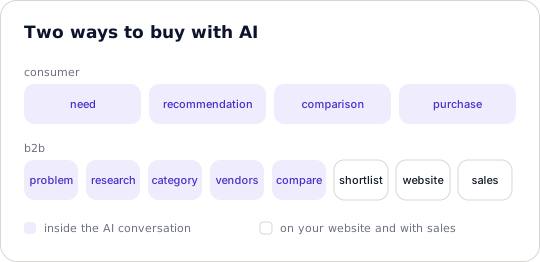
Consumer discovery is collapsing into a few steps inside a single AI chat. B2B discovery stays long, and the AI shapes the early part of it.
For a B2B brand, being included in those early conversations may matter more than appearing next to a price.
Being known is not the same as being recommended
This distinction is the heart of measuring brand mentions in AI search. Ask Claude, then Gemini:
What is Company X?
Both may describe the company perfectly. That says very little about its AI visibility. Now take the brand name out:
What are the best tools for measuring brand visibility across AI search engines?
Does the company still appear? If Gemini knows you when asked by name but never thinks of you during category discovery, you have recognition without much discovery, and the same goes for Claude. For a marketing team, "does the AI know who we are?" is the easy question. The harder and more useful one is whether the AI thinks of you when someone needs what you sell.
Why Claude and Gemini may recommend different brands
There is no master list of products sitting behind every assistant. Different models read the same question differently, their retrieval systems find different sources, they weigh that information differently, and the earlier turns of a conversation nudge the final answer. On top of that, Gemini draws on Google's product data for shopping questions.
The upshot is that a brand can be highly visible in Gemini and barely appear in Claude, or the other way round. That is not necessarily an error. There simply is no single AI search result, which is why prompt tracking has to cover several assistants instead of treating one as a stand-in for the whole market.
Recommendations are worth more than mentions
Not all AI visibility counts the same. Suppose your brand appears in this answer:
Other platforms in this category include Company A, Company B and Company C.
Now compare it with this one:
For a European company prioritising privacy and EU hosting, Company B is probably the strongest fit.
Company B appears in both, and the second mention is worth far more. It ties the brand to a specific problem and gives the reader a reason to consider it. That is why counting AI brand mentions on its own can mislead. You need the context around each one: was the brand recommended, was it compared favourably, which attributes were attached to it, which competitors sat beside it, and was the information accurate? A hundred passing mentions may be worth less than twenty strong recommendations on prompts close to a buying decision.
Sources matter too
Behind every recommendation sits another question: where did the information come from? Sometimes the AI leans on the company's own website. Often it draws on reviews, publishers, documentation, retailers, comparison sites, community threads, and other third parties.
That is worth watching. If Claude keeps recommending a competitor because independent sources call it the best option for a particular use case, another generic product page on your site will not change much. The gap may sit in what the rest of the web says about you. This is where AI citation analytics earns its place next to prompt tracking: brand monitoring tells you whether you appear, and citation monitoring starts to explain why an answer looks the way it does.
Can brands optimize for product recommendations?
Yes, though probably not with a single technical trick. AI systems need clear, credible information about the product: accurate descriptions, specifications, pricing where it makes sense, documentation, structured data, comparison information, and content that says plainly who the product is for.
Third-party information counts as well. Reviews, independent comparisons, industry publications, community discussions, and original research all help establish what a product is known for. For ecommerce, accurate product feeds and structured commercial data matter most in ecosystems like Google's. For B2B companies the task is broader. The AI needs enough evidence to understand what the product does and also when to recommend it over a competitor, which is a harder thing to earn.
What marketers should track
Typing your company name into Claude and Gemini every few months will not tell you much. A better approach is a stable set of prompts that follows the stages of discovery.
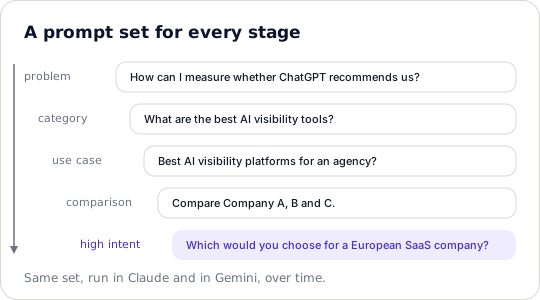
Track prompts at every stage of discovery, from the first problem to the final shortlist, and run the same set in each assistant.
Start with the problem:
How can I measure whether ChatGPT recommends my company?
Then the category:
What are the best AI visibility tools?
Then the use case:
What are the best AI visibility platforms for an agency managing multiple clients?
Then comparisons:
Compare Company A, Company B and Company C.
Then high intent:
Which AI visibility platform would you choose for a European SaaS company?
Run that set in both Claude and Gemini and the differences get interesting. You see where your brand appears, where competitors dominate, how each assistant describes you, and whether any of it shifts over time. Voris runs tracked prompts across ChatGPT, Perplexity, Gemini, Claude, and Grok for exactly this reason.
So, Claude or Gemini?
For consumer products, Gemini has a real structural advantage. It can combine AI reasoning with fresh product data, prices, availability, reviews, and a direct route to checkout. Claude can still give strong recommendations, especially when the decision involves detailed requirements, technical information, or awkward trade-offs. For B2B products the comparison is much less clear, and there may be no single winner at all.
From a brand's point of view, that is the useful conclusion. Customers will not settle on a single assistant for good. Some will use ChatGPT, others Gemini, Claude, Perplexity, Grok, or whatever arrives next year. A competitor might dominate Gemini's recommendations while you do better in Claude, and another might show up everywhere.
So the question to ask is less "which AI gives the best product recommendations?" and more "when people ask AI for products like ours, which assistants recommend us, and which ones recommend somebody else?" That one you can measure.