blog
The AI traffic hiding in your Direct channel
Every analytics dashboard has a junk drawer, and it is labeled Direct.
Officially, Direct means someone typed your address or used a bookmark. In practice, it means the visit arrived without a referrer, and the tool had nowhere else to put it. Email clients strip referrers. Apps strip referrers. Copied links carry none. Direct has always been part real loyalty, part measurement debris.
And now something new is accumulating in the drawer.
How an AI recommendation becomes a Direct visit
Picture the actual behavior. Someone asks an assistant for a recommendation. The assistant names your brand. What happens next, in the real world, takes several forms, and most of them destroy the evidence.
They copy the link from the answer and paste it into a browser. No referrer. Direct.
They read the answer on their phone, in an app, and tap through. App-to-browser handoffs routinely lose the referrer. Direct.
They do not click at all. They read the recommendation, remember the name, and type your address an hour later, or search your brand name, which at least lands in Search but credits the wrong influence entirely.
Only the cleanest case, a desktop browser click straight from the assistant's web interface, reliably carries a referrer that says where the visit came from. Everything else arrives looking like nothing happened before it. The influence is real.
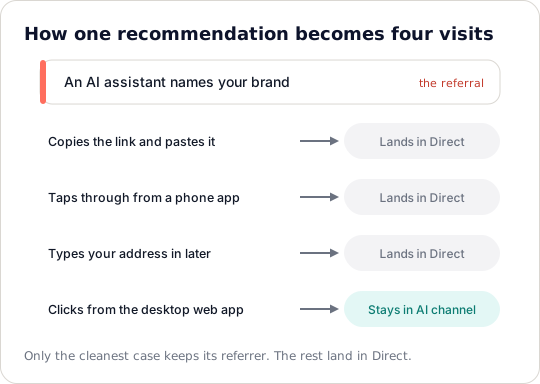
Only the cleanest case, a desktop click, keeps its referrer. Everything else lands in Direct. The evidence evaporates in transit.
Why this matters more than ordinary dark traffic
Email has had this problem for years and the world kept turning, so why care now? Two reasons.
First, the visitors are different. Someone arriving from an AI answer has already asked their question and already heard a recommendation. They show up late in their decision, with intent. Misfiling your highest-intent visitors as "source unknown" is not a rounding error, it is a hole in exactly the part of the funnel you most want to understand.
Second, the channel is growing while it hides. A channel that grows inside Direct produces a strange artifact: your dashboards show Direct creeping upward, someone in a meeting says "brand awareness is working," and an entirely different phenomenon goes unexamined. The misreading is not just incomplete, it points the conclusion in the wrong direction.
What can honestly be done
Here is where we are supposed to claim our tool sees everything. It does not, and nobody's does, and the vendors implying otherwise are the reason this category has a credibility problem.
What can be done, honestly, is this.
Catch every referrer that does survive. A surprising number of analytics tools still file chatgpt.com and perplexity.ai under generic Referral. A maintained list of AI assistant sources, treated as a first-class channel, recovers the visible portion of the iceberg properly. This is simple, factual, and the place to start.
Verify the agents. Visits from AI agents themselves, assistants reading your pages, agents comparing options on a person's behalf, can be identified and verified where the agent supports modern authentication standards, and classified where it does not. That separates the machine readership from the human one, which keeps both measurements honest.
Track the answers directly. Since the click trail is lossy, watch the source. If you know which questions produce citations of your brand, you no longer depend entirely on referrers to know the recommendations are happening. The citation record and the visible AI channel together bracket the truth that the referrer-stripped middle conceals.
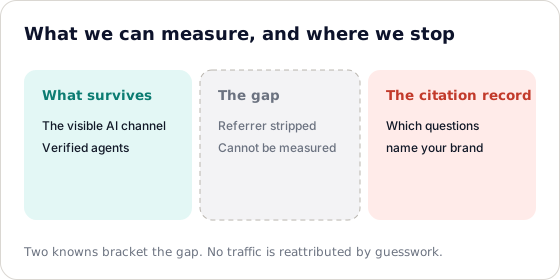
The visible channel and the citation record bracket the gap the stripped middle hides, and the boundary is drawn honestly.
Resist the urge to guess the rest. It is tempting to claim a model that reattributes Direct traffic to AI sources by inference. We do not do this, because an unfalsifiable estimate dressed as a measurement is worse than an honest gap. Where the data ends, the dashboard should say so.
The junk drawer will never be fully sorted. But the difference between "Direct is up, who knows" and "here is the visible AI channel, here are the verified agents, here are the citations driving both, and here is the boundary of what we can know" is the difference between an excuse and an answer.
Voris gives AI referrals their own channel and verifies the agents at the door. See how AI traffic analytics works →. Or start free and check your own junk drawer.