blog
The AI Citation Loop: from being mentioned to being measured
Somewhere in the last few years, a new step appeared in how people choose things, and most measurement stacks simply did not notice.
It looks like this. Someone needs invoicing software, or a hotel in Lisbon, or a CRM that does not require a consultant. They used to type that into a search engine and click through a page of blue links. Increasingly, they ask an assistant instead. The assistant answers in a paragraph, names two or three options, sometimes links one. A recommendation has happened. A shortlist has formed. And it formed in a place your analytics has never heard of.
If the person then clicks through, your analytics sees a visit. Maybe it gets filed under Referral, between a newsletter and a forum. Often the referrer does not survive the journey at all, and the visit lands in Direct, which is where analytics tools put things they cannot explain. Either way, the most important fact about that visitor, that a machine your customer trusts just recommended you by name, is nowhere in the record.
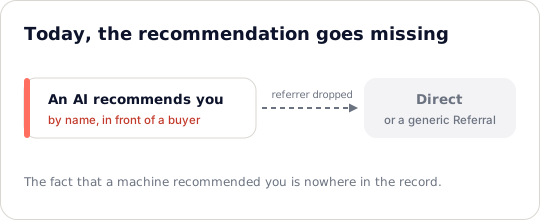
Today the recommendation vanishes: the referrer is dropped and the visit lands in Direct or a generic Referral.
That is the gap. Now here is the loop.
Four stages, one chain
The AI Citation Loop is the full chain from recommendation to revenue, and it has four stages.
Stage one: the citation. An assistant answers a question and your brand appears, with a link, a position, a sentiment, and usually some competitors for company. This is observable. You can ask the engines the questions your customers ask, on a schedule, and record what comes back. Not as one poll presented as truth, because AI answers vary between runs, but as a rate over time with the confidence stated.
Stage two: the visit. Some citations produce clicks. Those arrivals are identifiable when the referrer survives, and they deserve their own channel, next to Search and Social, rather than a shrug. AI-referred visitors tend to arrive having already had their questions answered, which makes their behavior on your site unusually interesting.
Stage three: the behavior. What does an AI-referred visitor do? Which pages, how long, where do they leave, where do they continue. This is ordinary analytics, applied to an extraordinary new audience.
Stage four: the conversion. The trial, the purchase, the signup. The thing the whole chain was for.
Each stage is measurable on its own. The value is in the joins. A citation that never produces visits is a different problem from visits that never convert, and both are different from not being cited at all. Without the joins, you are reading four disconnected charts and writing fiction in the gaps between them.
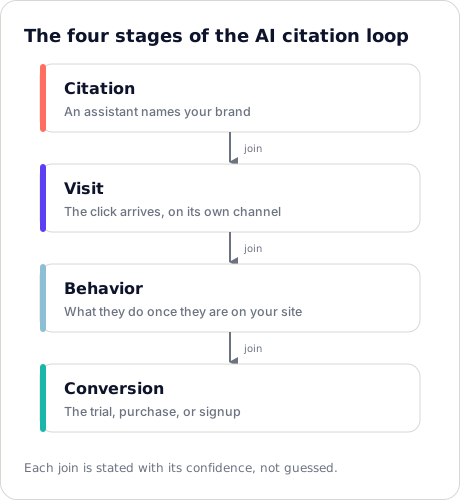
The AI citation loop: four measurable stages, joined into one chain from recommendation to revenue.
Why nobody joined it before
The two halves of the loop have historically lived in different products owned by different teams. Citation monitors watch the answers and stop there. Analytics tools watch the site and have no idea the answers exist. Joining them across two vendors means exporting CSVs and trusting a spreadsheet, which is where measurement goes to die.
There is also an honesty problem, and it deserves naming. The joins in this loop are probabilistic. The assistant's conversation is private, as it should be. What you can do is connect a tracked citation to the page it linked, watch for AI-referred arrivals on that page, and follow them forward, stating the confidence of each connection rather than implying certainty you do not have. Anyone selling you a deterministic version of this loop is selling you a story.
What changes when the loop closes
A closed loop turns AI visibility from a vanity chart into a decision tool. You learn which questions are worth competing for, because you can see which citations produce visitors who convert. You learn which of your pages the assistants prefer to link, and whether those are the pages you would have chosen. You learn, sometimes uncomfortably, that a citation you celebrated produces traffic that bounces, while a quieter one quietly pays the bills.
Mostly, you stop arguing from anecdote. "We should care about AI traffic" becomes a number, with a confidence interval, in the same dashboard as everything else.
The recommendations are already happening. The only question is whether you can see what they are worth.
Voris connects citations to visits to conversions, on your own first-party data, with the confidence shown. How the attribution works →. Or start free and watch your own loop close.